If “everyone can log in” is your clinic’s current security plan, you’re playing with fire. Not because your staff is untrustworthy. Because busy clinics create messy habits. Passwords get shared. Accounts stay active after someone leaves. Someone clicks the wrong screen and suddenly they’re staring at information they never needed in the first place.
That’s why role-based access control healthcare conversations matter, even for small clinics. Especially for small clinics. You don’t have extra time to clean up preventable mistakes.
At Altrue, the focus is solutions that deliver real impact in clinics. UltraVisit supports better care delivery by simplifying documentation, improving coordination, and helping teams stay on track in one streamlined system. UltraVisit is a Philippine-focused EMR + telehealth platform that supports clinic workflows from scheduling to charting, billing, and teleconsult follow-ups. And inside that system, secure access controls for your team are a practical foundation, not a fancy add-on.
Role-based access control healthcare is really about clinic sanity
People hear RBAC in EMR and think it’s purely technical. But the reason it matters is simple: you want fewer accidental exposures and fewer workflow interruptions.
A clinic is full of roles that don’t need the same access:
- Front desk staff handling scheduling and patient profiles
- Clinicians documenting encounters with SOAP notes
- Staff dealing with billing and receipts for cash based clinics
- Management reviewing reports for visits and income
If everyone sees everything, you don’t get “efficiency.” You get risk. And awkward moments. Like when a staff member opens the wrong patient record because the interface didn’t stop them. It happens. Quietly.
With role-based access control healthcare, the goal is to align access with the job. Nothing more. Nothing dramatic.
RBAC in EMR: the difference between “can do” and “should do”
In a clinic, someone might be able to access certain records. But should they?
That’s the heart of RBAC in EMR. It supports a cleaner boundary between responsibilities.
A simple way to think about it:
- If your role is scheduling, you need appointment visibility, not clinical notes.
- If your role is clinical documentation, you need encounter history, not full billing details.
- If your role is billing, you need transaction and receipt functions, not unrestricted chart access.
UltraVisit supports secure access controls for your team, which fits that practical expectation. It’s about making the right action easier, and the wrong action harder.
And yes, “harder” is a feature. Not a bug.
Secure team access is part of patient trust, even if patients never ask
Patients rarely walk in and say, “Hi, can you explain your permission settings?”
But they assume privacy. They assume boundaries. They assume a clinic behaves responsibly with their information.
If something goes wrong, trust disappears fast. And trust is hard to win back. So secure team access isn’t just a compliance checkbox. It’s part of your clinic’s reputation.
UltraVisit states it protects data in line with the Data Privacy Act of 2012, and its access controls support day-to-day privacy habits. The kind that matter when the clinic is busy and everyone’s moving quickly.
Staff permissions in clinic software also reduce mistakes
Here’s the underrated benefit: staff permissions in clinic software reduce operational errors.
When staff only see what they need, you get:
- fewer accidental edits
- fewer wrong-patient selections
- less confusion during peak hours
- clearer accountability when questions come up later
And accountability isn’t about blame. It’s about clarity. When a clinic is organized, the whole team feels less stressed.
UltraVisit supports workflows like:
- SOAP notes in seconds
- prescriptions you can print and save
- scheduling and patient profiles
- billing and receipts for cash based clinics
- reports for visits and income
- telehealth follow-ups and patient engagement tools
Access control helps keep these tools used the right way, by the right roles. That’s the whole point.
FAQ: What is role-based access control healthcare in plain language?
It’s a way to limit system access based on job roles. So staff can do their work without seeing or changing things that aren’t part of their responsibility.
UltraVisit supports secure access controls for your team, which helps clinics keep boundaries clear in daily operations.
RBAC helps clinics scale without turning into chaos
Even if your clinic is small today, growth changes everything.
More staff means:
- more logins
- more handoffs
- more chances for miscommunication
- more risk that someone sees something they shouldn’t
RBAC in EMR helps clinics scale without losing control. You’re not forced into complicated processes. You’re simply setting guardrails that keep workflows clean.
And guardrails are good. Like seatbelts. Nobody complains about seatbelts when they actually need them.
Practical clinic scenarios where secure access controls save you
Let’s make it real. Here are situations clinics run into all the time:
- A patient calls asking about a prescription
The staff member needs to confirm details, but they shouldn’t have full clinical note access if it’s not their role. - A billing question comes in weeks later
Your team needs to locate a receipt or billing entry tied to a visit, without exposing unnecessary medical details. - A teleconsult follow-up gets scheduled
The scheduling role needs appointment visibility and patient contact details, not full documentation editing privileges.
UltraVisit supports these workflows while keeping access aligned with team responsibilities. Less friction. Less risk. Better flow.
A quick view of access control by clinic role
Here’s a flexible way to picture role-based access. Not rules carved in stone. Just common sense.
| Clinic Role | Common Task Focus | Why RBAC Helps |
|---|---|---|
| Front desk | Scheduling and patient profiles | Limits exposure to clinical notes |
| Clinical team | SOAP notes and encounter updates | Reduces accidental admin edits |
| Billing | Receipts and transaction tracking | Keeps financial work clear and contained |
Three columns. Easy on the eyes. Even on a phone.
Don’t let “shared logins” become your clinic’s hidden habit
Shared accounts often start as convenience. Then they become normal. Then they become impossible to untangle.
And when something goes wrong, you can’t confidently answer basic questions like:
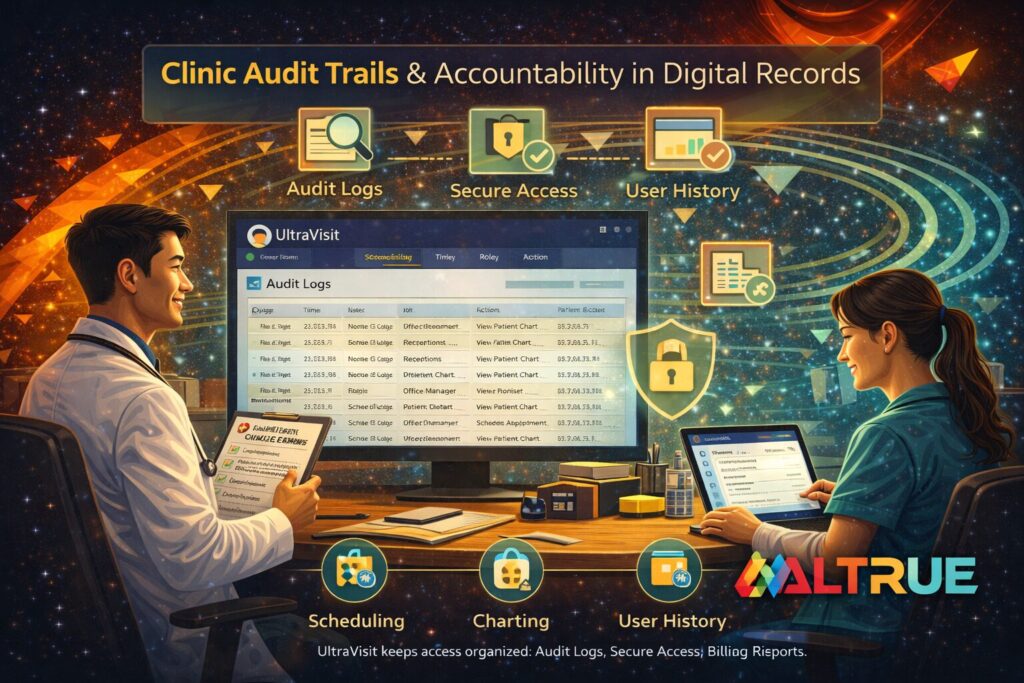
- Who accessed this record?
- Who updated this note?
- Who issued this receipt?
Role-based access control supports cleaner boundaries, and it supports clearer responsibility. Not paranoia. Just good operations.
The best access controls disappear into the workflow
Here’s what you want. You don’t want staff thinking about security all day. You want security to quietly support the workflow.
When access controls are done well:
- staff can do their job smoothly
- patients’ information stays protected
- the clinic feels more organized
- fewer “oops” moments happen in the background
UltraVisit supports a clinic workflow platform where secure access controls for your team align with real tasks like scheduling, documentation, billing, and follow-ups. And that’s what makes it practical. It fits how clinics actually run.
If you want to explore how Altrue and UltraVisit can support role-based access control healthcare and more responsible clinic system access, reach out through this Contact Us page.