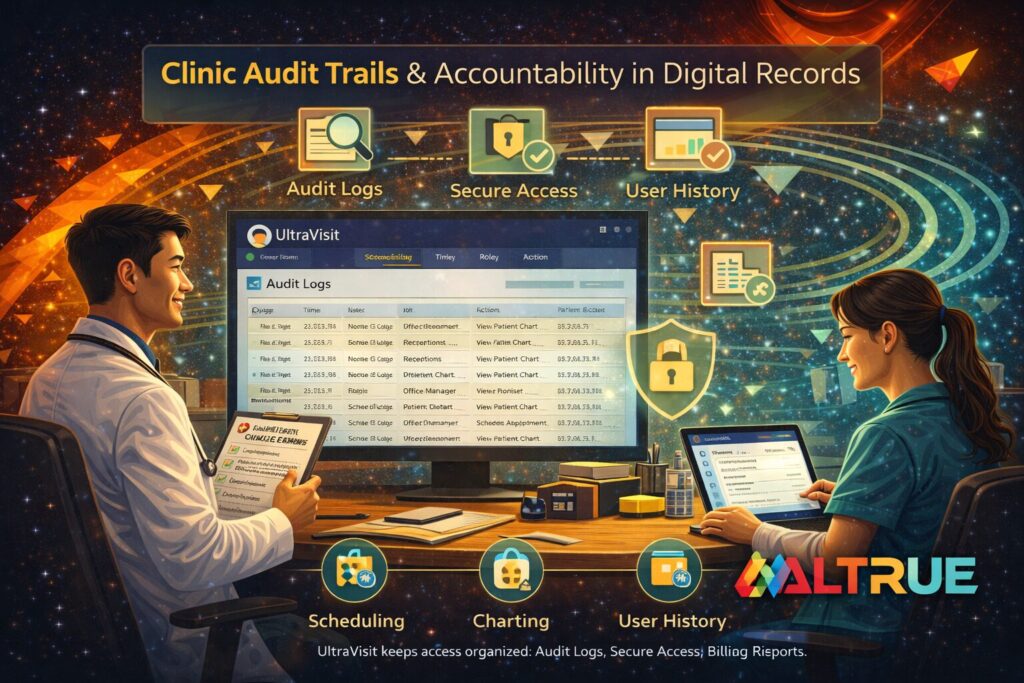
Every clinic eventually gets hit with the surprise quiz.
A patient dispute. A confusing note. A billing question that pops up weeks later like it’s been waiting for the perfect moment. And suddenly everyone’s asking the same set of questions, usually in the same slightly panicked tone:
“Who changed this?”
“When did this happen?”
“Do we have proof?”
“Why does nobody remember?”
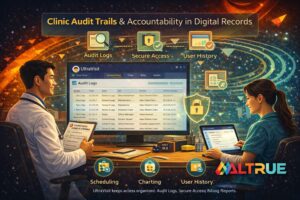
That’s where clinic audit trails stop being a “tech feature” and start being a safety net. Audit trails are about accountability. They protect the clinic, they protect the staff, and they protect patient trust when questions come up.
At ALTRUE, UltraVisit is positioned as a Philippine-focused EMR + telehealth platform designed to support smoother clinic workflow from scheduling to charting, billing, and teleconsult follow-ups. UltraVisit also states alignment with the Data Privacy Act of 2012 (RA 10173) and supports secure access controls for clinic teams. In real clinic language, that means: responsible access, better visibility, and fewer “we’re not sure” moments around sensitive records.
Let’s break down EMR audit trail and accountability in a way that actually makes sense for clinic owners and staff.
EMR audit trail: what it means in plain clinic language
An EMR audit trail is basically a history of activity inside your system. It helps you answer questions like:
- who accessed the record
- when a note was updated
- what changed in the documentation
- which account performed the action
Think of it as footprints. Not to spy on people. To make sure you can trace what happened when something needs to be reviewed.
Paper records can show you a page. They can’t tell you who touched it, when they touched it, and what exactly changed along the way. Paper is good at existing. It’s not great at proving.
Accountability in medical records protects staff too
A lot of people hear “accountability” and think punishment. Like someone’s about to get called into a meeting with that “we need to talk” tone.
But in clinics, accountability often protects staff from unfair blame.
When records are unclear, teams fall into:
- guessing
- finger-pointing
- “I think it was this” conversations
- long meetings that solve nothing
Clear accountability supports:
- quicker clarification
- cleaner handoffs
- fewer misunderstandings
- more confidence in the record
UltraVisit supports secure access controls, which is part of accountability. When access is aligned to roles, you reduce accidental edits and unnecessary exposure. And honestly, you reduce drama. Less “who did this,” more “here’s what happened.”
Access logging healthcare: why it matters even on normal days
You don’t need a crisis to benefit from access logging healthcare habits. Routine clinic questions happen constantly:
- “Did we already document this visit?”
- “Was the prescription updated?”
- “Who issued the receipt?”
- “Was the follow-up actually planned?”
When your workflow is connected, fewer of these questions turn into investigations.
UltraVisit supports a connected workflow that includes:
- SOAP notes
- prescriptions you can print and save
- billing and receipts for cash based clinics
- reports for visits and income
- telehealth follow-ups and patient engagement tools
When documentation, billing, and follow-ups are captured consistently inside one system, you spend less time “looking for the truth.” The truth is already there.
And yes, this saves time. But it also saves energy. Big difference.
FAQ: What does an EMR audit trail help with during disputes
During disputes or questions, an audit trail can support clarity around timing and access. Clinics often need to confirm what was documented and when updates occurred. A system that supports accountable access reduces guesswork and protects everyone involved.
UltraVisit supports secure access controls and structured documentation workflows that help keep records more defensible.
Audit log EMR and operational reliability: small habits build strong records
Clinic reliability isn’t built from big speeches. It’s built from tiny habits that happen every day:
- documenting visits on time
- storing prescriptions with the encounter
- keeping billing records aligned with the visit
- tracking follow-ups consistently
UltraVisit supports these habits through tools like SOAP notes, saved printable prescriptions, cash-based billing tools, and reporting. The more your team can keep these actions inside one workflow, the less you rely on memory and side notes.
And side notes are the enemy of accountability. They’re invisible. Inconsistent. Hard to defend later. “I wrote it on a sticky note” does not hold up well when someone asks for clarity.
Accountability in digital records needs role-based boundaries
Here’s where clinics get tripped up: if everyone can see and edit everything, accountability becomes messy.
UltraVisit supports secure access controls, which helps align access with responsibilities:
- scheduling roles focus on scheduling and patient profiles
- clinical roles focus on documentation
- billing roles focus on billing and receipts
- admin roles focus on operational visibility like reports
When access is controlled, staff can work more confidently and you reduce accidental changes. That supports accountability without turning the clinic into a tense, micromanaged environment.
People do better work when boundaries are clear. It’s that simple.
FAQ: Is access logging healthcare the same as monitoring staff
Not exactly. Many clinics treat access logging as a way to support accountability and privacy, not as a way to micromanage. The goal is clarity when questions arise and safer handling of sensitive patient records, not “gotcha” monitoring.
UltraVisit supports secure access controls that help align system use with roles.
Audit trails support data privacy expectations in real life
Privacy and accountability go together.
When you can track access and changes, you can:
- reduce casual browsing of patient records
- identify unusual access patterns
- reinforce trust through responsible handling
- align internal behavior with privacy expectations
UltraVisit states alignment with RA 10173, and secure access controls support privacy-aware workflows. Accountability isn’t separate from privacy. It’s one of the ways privacy becomes real inside day-to-day operations.
Because policies don’t protect patients by themselves. Habits do.
How to explain audit trails to your team without making it weird
If you introduce audit trails with the wrong tone, people get defensive. Fast. Nobody likes feeling suspected.
A healthier framing is:
- “We want our records to be reliable.”
- “We want fewer mistakes and fewer disputes.”
- “We want clear boundaries so everyone can work confidently.”
UltraVisit supports a connected system that reduces fragmentation and supports responsible access. When workflow is cleaner, accountability stops feeling like blame. It becomes a normal part of running the clinic well.
And yes, culture shows up in the patient experience. Patients can feel when a clinic is organized. They can also feel when a clinic is always scrambling.
When the system supports accountability, it feels like calm
A clinic doesn’t need to be paranoid. It needs to be organized.
When digital records are structured and access is controlled, accountability becomes a calm tool:
- questions get answered faster
- staff feel protected by clear records
- patient trust stays intact
- leadership decisions get clearer
UltraVisit, powered by ALTRUE, supports the workflows that build this consistency through scheduling, documentation, billing, reporting, and follow-up tracking. The best version is when accountability becomes almost invisible. It’s just how the clinic runs.
If you want to explore how ALTRUE and UltraVisit can support EMR audit trail accountability habits and more reliable digital record workflows, reach out through this Contact Us page.