You feel it when systems don’t talk to each other. Delayed reports. Duplicated data. Features that take forever because the backend is tangled like old headphones. If that sounds familiar, you’re not alone. Many teams ship great frontends while the backend lags behind. The fix is not another quick patch. It’s clean, deliberate integration that makes your stack feel like one system, not six taped together.
That’s exactly where Philippines backend code integration services shine. With a pragmatic approach to wiring APIs, databases, microservices, and third-party platforms into one coherent flow, you reduce friction, lower costs, and move projects faster. And yes, users notice when everything just works.
Why backend code integration matters when you need speed and stability
Let’s cut to it. Every product promise relies on the backend. Checkout needs inventory, identity checks need consistent sessions, analytics need real events, operations need clean data. When you integrate your systems well, you get fewer surprises and calmer releases. When you don’t, you get outages right when traffic spikes.
A well integrated backend does three things for you:
- Removes redundant work so features don’t stall in approvals or handoffs
- Keeps data consistent across services, environments, and teams
- Shortens release cycles because the plumbing is predictable
Build that foundation once and you’ll feel the compounding effects. Performance improves. Bugs drop. Developers focus on product logic instead of firefighting.
What Philippines backend code integration services include
This isn’t just wiring endpoints together. It’s a complete service focus on how your systems exchange data and handle growth. Common workstreams include:
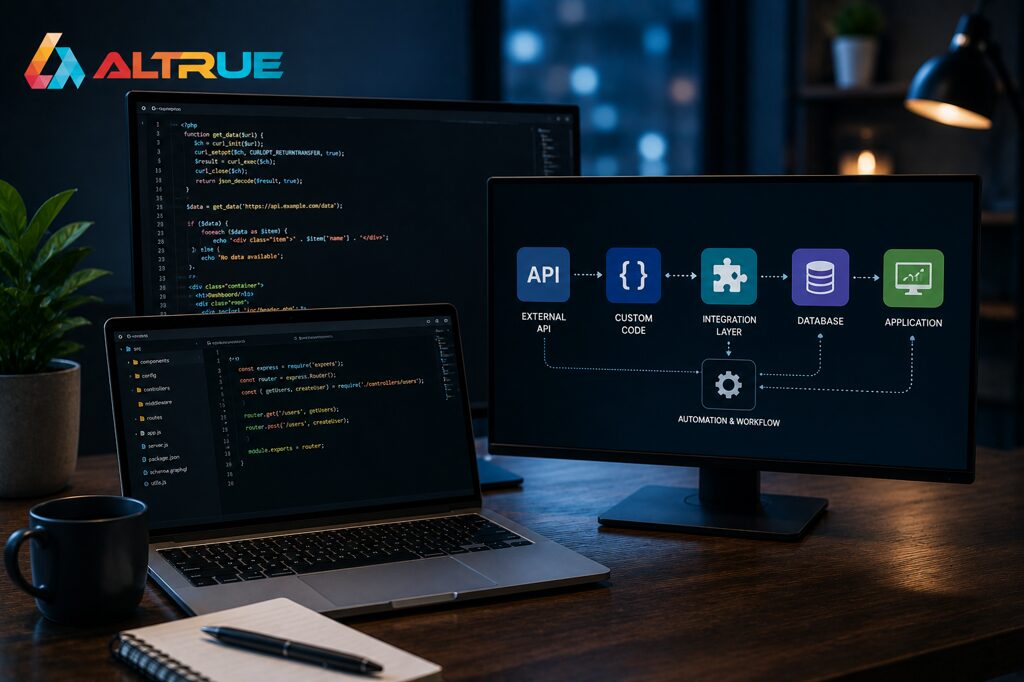
- API integration and orchestration so services communicate reliably and gracefully handle retries, timeouts, and versioning
- Data synchronization across operational databases, analytics stores, and downstream systems
- Authentication and authorization flows that keep user permissions consistent across apps
- Event driven patterns for near real time updates without brittle cron jobs
- Legacy system bridges that modernize without risky rewrites
- Observability hooks for logs, metrics, and traces that make issues visible early
Different teams need different mixes. The point is to deliver Philippines backend code integration services that actually match your stack and your roadmap, not a one size approach.
Seamless API integration for new and legacy systems
Some of your systems are shiny. Others are battle tested and touch revenue every day. Replacing everything is rarely the answer. You want integration that respects what already works and progressively modernizes what doesn’t.
- For new services you’ll want clean contracts, well versioned endpoints, and defensive error handling
- For older systems you’ll want adapters and anti corruption layers that protect the core while enabling new features
- For third party platforms you’ll want controlled rate usage, queued processing, and graceful fallbacks
And because APIs rarely behave the way docs suggest, resilience patterns matter. Retries with backoff, circuit breakers, idempotency keys. Boring to talk about. Magical when traffic surges.
Data pipelines and database integration without the headaches
Here’s where a lot of teams struggle. Data shows up late, out of order, or not at all. Reports don’t match what product managers see in app. People lose trust. Integration solves that by designing how data moves from capture to insight with intent.
- Change data capture techniques to keep sources and targets aligned
- Schema management that evolves safely as features grow
- Batch and streaming where each is actually appropriate
- Data quality checks so bad records don’t silently spread
A steady, visible pipeline means your dashboards update when they should and your product decisions aren’t flying blind. That’s not just technical hygiene. That’s business clarity.
Microservices, monoliths, and picking the right integration strategy
Monoliths are not evil. Microservices are not a cure all. Both can be brilliant with the right integration approach. What matters is alignment with your team size, deployment model, and release cadence.
- If you’re small and shipping fast, a modular monolith with clear boundaries can be a dream
- If you’re at scale with distinct domain teams, microservices with well defined contracts can unblock parallel delivery
- If you’re in between, hybrid patterns keep you from over engineering before you’re ready
Either way, contract clarity and observability are non negotiable. They’re how you keep responsibilities clean and reduce integration friction as your system grows.
Security and compliance built into every integration
Security isn’t a final checklist. It lives inside integration choices. You’ll want:
- Least privilege access for services and jobs
- Token management that rotates and scopes credentials correctly
- Input validation and sanitization at every boundary
- Encrypted transport and storage for sensitive data
- Audit trails so you know who touched what and when
The best part of baking this into integration work is simple. You prevent the class of incidents that never should have reached production. Quietly. Predictably.
A simple way to spot integration gaps
A quick snapshot can help you see where to focus first:
| Integration area | What it solves | Signs you need it now |
|---|---|---|
| API orchestration | Consistent communication between services | Frequent timeouts, brittle retries, flaky deployments |
| Data syncing | Fresh, reliable data across systems | Reports don’t match app, manual CSV fixes |
| Auth integration | Unified sessions and permissions | Users re login often, confused access levels |
| Event flows | Real time updates without polling | Cron sprawl, missed updates, slow feeds |
| Legacy bridges | Safe modernization path | Rewrite backlog grows, risky hotfix culture |
If two or more of those pain points sound familiar, integration is your highest leverage project.
How to measure ROI from backend integration
Integration often feels like an invisible win. Until you measure it. A straightforward scorecard works well:
- Lead time for change How long from pull request to production
- Change failure rate How many releases cause rollbacks or incidents
- Mean time to recovery How quickly you restore service during issues
- Cycle time per feature How long a typical feature takes end to end
- Support ticket volume Especially the repetitive “works for me” kind
Nudge any two of those in the right direction and the business impact is obvious. Fewer production fires. Faster roadmaps. Happier users. You can feel the difference in your week.
Why choose Philippines backend code integration services
Three practical reasons keep coming up for teams that decide to build in the Philippines:
- Depth of engineering talent with strong fundamentals and collaborative culture
- Time zone overlap that supports rapid feedback loops across regions
- Cost efficiency without cutting corners on quality or reliability
What matters most, though, is the mindset. Careful about standards. Flexible with real world constraints. And a healthy respect for the systems you already rely on.
Delivery model that respects your roadmap
Every team has constraints. Sprints already planned. Hard release dates. Vendors in the mix. A good integration partner adapts to your reality:
- Embeds with your developers for shared context
- Works in your version control and CI flow
- Favors incremental releases over giant migrations
- Documents contracts and behavior in plain language
- Leaves your team owning the system with confidence
No drama. Just steady progress and fewer surprises. That’s the whole point.
Quick FAQ on backend code integration services
What does Philippines backend code integration services cover for growing teams
It typically covers API integration, data synchronization, auth flows, and event driven updates across your applications. The goal is a backend that behaves like one system, even when it’s made of many parts. You get faster releases, cleaner data, and fewer late night incidents.
How long does backend integration usually take
Scope varies. Small wins can land in a couple of sprints. Broader integration programs stretch across quarters with staged milestones. The smart play is to pick visible targets first so your team feels the momentum.
Common pitfalls you can skip with the right integration approach
Let’s call out the traps that waste time and goodwill:
- Tightly coupled services that break when one team moves fast
- Unversioned APIs forcing risky synchronized releases
- Hidden dependencies found only during incident calls
- Copy pasted auth logic scattered across services
- Manual data fixes that never end and never scale
You don’t need to learn these the hard way. Set guardrails early and your future self will quietly thank you.
What a clean handoff looks like after integration work
This is the picture you want when engagement wraps:
- Clear interface contracts with examples for common scenarios
- Runbooks for failure modes and recovery paths
- Dashboards that surface latency, errors, and throughput
- Backlog of next improvements with estimated effort
- Ownership mapped to teams so responsibilities stay crisp
Feels boring on paper. Feels fantastic when you’re in the release crunch and everything holds.
The human side of integration work
Yes, the tech matters. But the way people work together matters just as much. Integration projects succeed when teams share context, agree on boundaries, and write things down. A little empathy goes far. Questions get asked sooner. Decisions age better. And when weird edge cases show up, the team solves them instead of throwing tickets over the wall.
And that quiet confidence your users feel when the app just flows. That’s the payoff. You already know the rest.
Ready to cut through the backend clutter and ship with confidence? If you’re aiming for dependable, scalable results with Philippines backend code integration services, let’s make your systems play nicely together from the start. Contact us here and we’ll map the clearest path forward.