Tired of guessing? Ads feel random. Content feels loud. Budgets wander. Meanwhile, the right customers scroll right past you because your message didn’t meet them where they were—or when they were ready. The fix isn’t louder creative. It’s data-driven digital marketing strategy and audience research that turns hunches into signals you can act on. Clean inputs. Focused bets. Steady wins.
Let’s build a plan that fits how people actually decide—and how your team actually ships. Practical. Human. Measurable.
Why data-driven digital marketing strategy and audience research beats guesswork
Good growth isn’t an accident. It’s the compounding effect of decisions made with evidence, not ego. Pairing digital marketing strategy and audience research gives you three edges:
- Sharper targeting because you know who buys, why, and what gets them to take the next step
- Cleaner messaging as headlines, offers, and visuals map to real jobs-to-be-done
- Smarter spend with channels ranked by incremental value, not last-click illusions
You’ll feel it fast—lower CPAs, higher quality leads, calmer retros. Not fireworks. Just quiet, repeatable wins.
Build your audience research baseline (without analysis paralysis)
You don’t need a 60-page deck. You need a baseline you can update every month.
- Define segments you can reach
Demographic is fine; behavioral is better. Think “first-time researchers,” “comparison shoppers,” “ready-to-switch.” - Interview for motivations and blockers
Five to eight short calls. What triggered the search. What almost stopped them. Which proof changed their mind. - Mine your own data
CRM fields, win-loss notes, support tickets. Look for repeated phrases—those become copy gold. - Review search patterns
Long-tail queries reveal intent (“how to switch from X,” “best [service] for small teams”). Use them to write helpful content, not just ads. - Map objections to proof
Price concerns, time-to-value, trust. Pair each with a specific proof: testimonial, stat, comparison table, or free trial step.
Keep it scrappy. Update monthly. This isn’t a thesis; it’s a compass.
Turn insights into a digital marketing strategy your team can run
Insights don’t help until they hit the calendar and the creative. Make the strategy runnable.
- Pick one north-star metric
Revenue? Qualified leads? Trial-to-paid conversions? Choose one. Let everything else support it. - Choose two supporting metrics per channel
Example: for search, qualified clicks and first interaction ROAS; for social, thumb-stop rate and add-to-cart start. - Set stage goals
Awareness, consideration, conversion, loyalty. Each gets 1–2 concrete actions and 1–2 measures that matter. - Write simple rules for creative
One message per ad. One CTA per page. Proof close to the decision. Avoid clever where money moves. - Add guardrails
Budget caps, frequency caps, and a maximum cost-per-incremental-action you’ll tolerate before pausing.
Small plan, big clarity. The team stops guessing what “good” means.
Channel stack that fits your funnel (with budget sanity)
Not every channel deserves a slice this month. Rank them by incremental lift and required certainty.
| Funnel stage | Channel focus | Best for | What to watch |
|---|---|---|---|
| Awareness | Short-form video, discovery ads, influencers | New audiences, story-first hooks | Thumb-stop rate, video completes |
| Consideration | Search, SEO content hubs, comparison pages | High intent researchers | Qualified clicks, engaged sessions |
| Conversion | Branded search, retargeting, email triggers | Ready-to-buy and cart/lead recoveries | Add-to-cart start, form completion |
| Loyalty | Email lifecycle, referral prompts, community | Repeat purchases and advocacy | Repeat rate, referral-assisted revenue |
Start where intent is high (search and triggered email), then earn your way up the funnel as creative sharpens.
Creative that speaks like a human (and converts like a pro)
People buy when they understand. Not when they’re impressed.
- Lead with the outcome they want in the first line
- Use one promise per asset so memory sticks
- Place proof near doubt quotes, tiny stats, recognizable logos—right where the pause happens
- Write microcopy like a teammate who knows the next step, not a judge
A quick creative checklist you can paste into briefs:
- Headline: outcome first, under eight words
- Subhead: how it works in one sentence
- CTA: verb + outcome (“Start free”, “See pricing”, “Get a demo”)
- Proof: one quote or stat within one scroll
- Visual: show the result, not just the product
Measurement that changes decisions (not just dashboards)
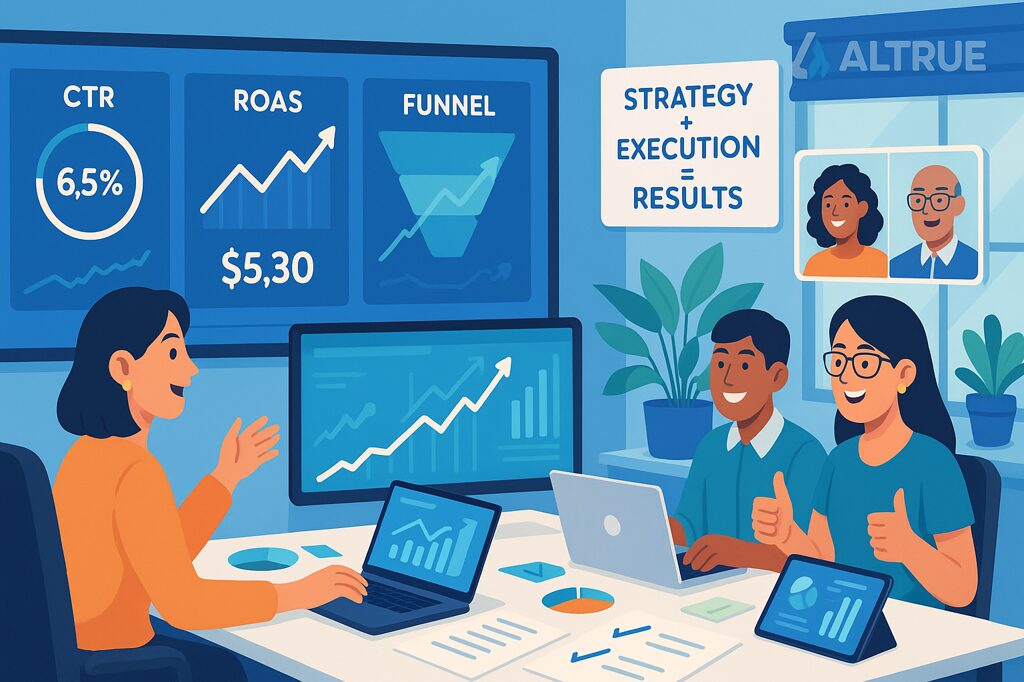
Track less. Decide more. Here’s a practical scoreboard your team can own:
- North-star: the one number that pays the bills
- Activation checkpoints: first success actions that predict retention
- Incrementality tests: geography or audience-level holdouts where possible
- Creative contribution: which messages show up in winning journeys
- Time-to-meaning: how long until a test reaches a decision threshold
Tip: set minimum sample and stop rules. Tests that never end are just expensive hobbies.
A/B testing and iteration that compounds
Experiments should feel small and frequent. Think weeks, not quarters.
- Test ladders
- Proposition, 2) Offer, 3) Visual/format, 4) CTA framing, 5) Layout. Only move down when the tier above stops moving numbers.
- Sequential rollout
Start in one region or audience slice. If it wins, scale. If it’s flat, retire fast. - Field reality checks
Run creative on mid-range phones. If a hook requires perfect conditions to land, it won’t survive the feed. - Fail notes
Write two lines: What we thought, what we learned. Future you will thank you.
What is digital marketing strategy and audience research
It’s the paired discipline of understanding who your buyers are—what they need, fear, and believe—and then building a channel and creative plan that meets them with relevant offers, proof, and timing. The goal: predictable growth with fewer expensive bets.
How fast can you see results from data-driven digital marketing strategy and audience research
Often within a few cycles. High-intent fixes (search queries, landing page clarity, triggered emails) move early. Upper-funnel work compounds as creative gets sharp. Not overnight. Not glacial either.
Content and SEO: build demand you don’t have to rent forever
Paid can open doors. Content keeps them open.
- Topic clusters around jobs-to-be-done, not just keywords
- Comparison and alternatives pages that answer the messy middle honestly
- FAQ hubs for voice search and quick answers (yes, AEO helps)
- Data-backed posts using your own anonymized insights; unique beats generic every time
- Internal links that guide discovery to decision without detours
SEO is slow only when content is generic. Make it specific, useful, and fast to load.
Landing page patterns that reduce bounce and raise intent
Pages convert when they remove confusion. Keep the pattern consistent across campaigns.
- Above-the-fold promise with one action
- Credibility slice near the first scroll (logos, stat, or quote)
- 3-bullet benefits tied to outcomes, not features
- How it works in three steps (pictures help)
- Risk reducer free trial, guarantee, or clear next step
- FAQ anchored to objections heard in interviews
Short forms until trust is earned. Save “everything about you” for later.
Budgeting and forecasting that won’t wreck your quarter
Simple beats sophisticated when the inputs are fuzzy.
- Set a base CPA/CPL you refuse to exceed (incremental where you can measure it)
- Use rolling four-week averages to smooth spikes before you panic
- Pre-allocate 10–20% for tests (new channels, new hooks) and protect it
- Reinvest from winners first before adding fresh spend elsewhere
Finance will love you. So will your sleep schedule.
Attribution that’s honest (and useful)
No model is perfect. Make yours consistent and transparent.
- Channel-level rules documented in one page—what gets credit, what doesn’t
- Assisted revenue tracked for content and mid-funnel assets
- Lift studies quarterly where possible (geo splits, PSA controls)
- Qual notes from sales and support folded into dashboards (context beats precision)
When numbers and stories agree, decisions get brave.
A two-sprint plan you can steal
Sprint 1
- Interview five customers; extract top objections and triggers
- Rework two landing pages to the pattern above
- Launch three high-intent ad groups with outcome-first copy
- Set up activation checkpoints and start rate tracking
- Write the stop rules for tests
Sprint 2
- Build one topic cluster page and two comparison pages
- Refresh retargeting with proof near doubt
- Run a proposition test in one region; hold out another
- Tighten budgets to rolling averages; protect the test slice
- Document learnings, pick the next obvious win
No drama. Just momentum.
Common pitfalls you can skip
Let’s name them so you don’t pay the tuition.
- Measuring everything, acting on nothing
- Running ten tests at once and learning nothing from any
- Chasing last-click and starving mid-funnel content that actually moves decisions
- Writing clever copy where clarity should live
- Sending ad traffic to generic homepages instead of intent-matched pages
Fix two this month and your next quarter feels different. Calmer.
The human side of data-driven growth
This work respects people. Your audience, who want the right help at the right time without a maze. Your team, who deserve fewer fire drills and more small wins. And you, because watching a clean plan turn into steady leads and sales never gets old. When a stranger reads a headline and thinks “finally, that’s me,” then clicks, then buys—that quiet yes is the sound of strategy working.
Ready to build a digital marketing strategy and audience research program that actually moves numbers week after week? If you want that calm lift, contact us and we’ll map your first wins.