A good-looking app can still lose people in ten seconds.
One confusing button. One slow screen. One form that asks too much too soon. A checkout step that feels unclear. A login that keeps failing for no obvious reason. Users do not always complain. Most of the time, they just leave.
That is why user-tested app development services in the Philippines matter. An app should not only work in a developer’s test environment. It should work for real people, on real devices, with real habits, bad internet days, short patience, and zero interest in reading a manual.
User-Tested App Development Services In The Philippines Build Trust Early
People trust apps that feel easy.
Not because the design is fancy. Not because the logo is big. They trust apps when the next step feels obvious, the screen loads properly, and the feature does what it promised.
That sounds simple.
It is not always simple to build.
Real Users Notice What Teams Miss
A business team may understand the product too well. Developers may know where everything is supposed to go. Designers may assume the flow is clear because they have looked at it for weeks.
Then a real user taps the wrong thing in five seconds.
That moment is useful.
User testing catches confusion early. It shows where people pause, where they get annoyed, where they abandon the process, and where the app asks for too much effort.
Better to discover that before launch than after the bad reviews arrive.
App Development Should Start With The User, Not The Feature List
Many apps become crowded because everyone wants to add “just one more feature.”
One more button. One more dashboard. One more form field. One more notification.
Before long, the app feels heavy.
User-tested app development keeps the focus on what people actually need to do. Can they sign up without confusion? Can they complete the main task quickly? Can they find help? Can they understand the screen without asking someone else?
Testing Makes The App Feel Cleaner
A tested app usually feels simpler because unnecessary friction gets removed.
That may mean shorter forms, clearer labels, better menu placement, faster loading, or fewer steps between the user and the result they want.
Small changes.
Big difference.
Especially in the Philippines, where users may switch between devices, mobile data, public Wi-Fi, and older phones. If the app only performs well in perfect conditions, it is not ready for real use.
Why Businesses Choose User-Tested Development
Skipping user testing may feel faster at first.
But launching an app with avoidable problems usually costs more later. More support tickets. More bug fixes. More confused users. More awkward messages from customers saying, “Hindi ko ma-open.”
Nobody wants that after launch week.
Testing Helps Reduce Expensive Rework
User testing helps businesses spot problems before they become public problems.
It can improve:
- Onboarding flow
- Navigation
- Form completion
- Button placement
- Page speed
- Error messages
- Feature usability
- Overall user confidence
This is not only about design. It is about protecting the business from preventable mistakes.
Altrue PH Builds Apps With Real-World Use In Mind
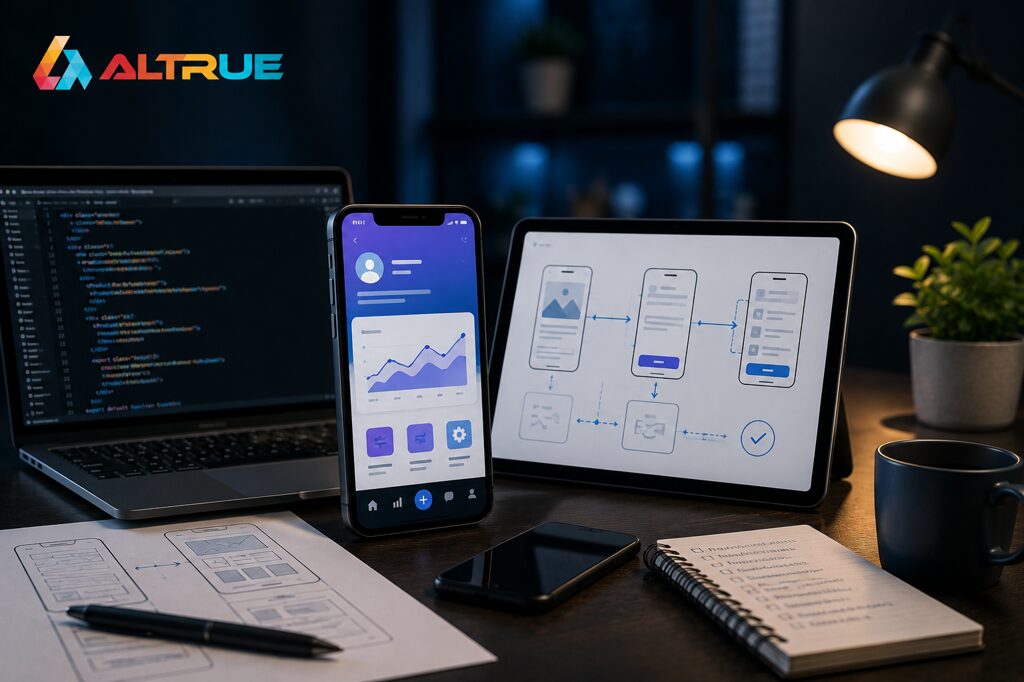
Altrue PH approaches app development with the user experience at the center.
That means planning the app around actual behavior, not just internal assumptions. The process looks at what users need, how they move through the product, where confusion might happen, and how the app can feel reliable from the first use.
A Better App Feels Natural
Users should not feel like they are solving a puzzle.
They should open the app, understand what to do, and move forward without guessing. When the experience feels natural, people are more likely to return, recommend, and trust the brand behind it.
That trust matters.
An app is often one of the first serious interactions people have with a business. If the app feels careless, the brand feels careless too.
Build An App People Actually Want To Use
The best app is not always the one with the most features.
It is the one people can use without frustration.
User-tested app development services in the Philippines help businesses build digital products that feel practical, clear, and dependable. The goal is not just to launch. The goal is to launch with confidence.
If your business is ready to build an app that users can trust, understand, and actually enjoy using, connect with ALTRUE PH through Contact Us.